

From Impact to Change: The Evolution Most Nonprofits Never Make


On our first Zoom call, Ellen Marshall said something that I asked her to explain: “Impact is not the same as change.” That led to an hour-long conversation. She puts nonprofit work on a spectrum, impact on one end, change on the other. I understood the distinction, but it took about a month of nonprofit roundtables and conversations with people focused on impact before I saw the deeper point. Her spectrum is also a journey. Every nonprofit that wants to stay connected to the people it serves needs to start with impact. But most do not evolve much beyond it. They grow the numbers: more people served, more programs funded. But that growth often does not translate into the kind of systemic change that addresses why the problem exists in the first place. I think that comes down to how the organization is designed, not mission or ambition.
"Change is not the same as impact." — Ellen Marshall
Where Every Organization Starts
Impact is the beginning. It has to be. You see a problem, you act on it. Kids need coats, so you distribute coats. Families need food, so you run a food pantry. Someone is hurting, and you do something about it. This is where mission meets the world for the first time, and there is nothing wrong with it.
Impact work is downstream by nature. It deals with the fallout of problems that already exist. It counts outputs, writes annual reports, and applies for next year’s grant. The work is necessary, often urgent, and it builds the credibility and community knowledge an organization needs to survive its early years.
Starting here is fine. Staying here for thirty years is a different conversation.
Why the Closest Engine Is the Slowest

Societal change has three primary engines: for-profit companies, government, and nonprofits. Each one has driven real shifts in how people live. Each one carries trade-offs that shape what kind of change it can produce.
For-profit companies are exceptional at scale. Apple integrated hardware, software, and services into a single product and restructured how billions of people access information, communicate, and organize their economic lives. The industrial revolution and the information economy were structural interventions that reshaped conditions for everyone, driven by market logic and integration. The change they produce is powerful. It is also indifferent. The feedback loop runs through revenue, not human outcomes, and the cost falls wherever the market decides.
Government operates differently. It has the authority to intervene upstream, to change conditions through policy at a scale no single organization can match. Philadelphia reduced the number of children in foster care by nearly 60% since 2017 by keeping families together rather than separating them at the point of crisis. But government moves slowly, faces political constraints, and often makes decisions at a distance from the people most affected by them.
The engine with the most potential to drive human-centered change is the one least equipped to do it.
Then there are nonprofits. Closer to the people who need change than either of the other two. Carrying the community relationships, the ground-level knowledge, the trust that comes from showing up when no one else does. A nonprofit working on housing instability understands the problem at the level of individual families, neighborhoods, and local systems in a way that neither a corporation nor a federal agency typically can. Of the three engines, nonprofits are the best suited to drive change that stays connected to the people it is meant to serve.
And yet they are not producing societal change at anywhere near the rate of the other two. For-profit companies and government have reshaped the conditions of modern life repeatedly, for better and worse. The nonprofit sector, for all its proximity, has largely remained in the business of managing downstream effects.
That imbalance is worth sitting with. The engine with the most potential to drive human-centered change is the one least equipped to do it. The gap runs deeper than mission or will. It is structural. If nonprofits can learn the scaling lesson that for-profit companies have mastered, the lesson of building networks where value compounds rather than resets, the balance of how society shifts could look fundamentally different, and the change would be more connected to the people who need it.
The Linear Trap

The reason the nonprofit engine stalls isn’t mission-level. It’s structural, and network theory offers a useful way to see it.
Metcalfe’s Law observes that the value of a network grows not with the number of users but with the connections between them. A phone is useless with one user. It becomes transformative with a million. The insight isn’t a precise formula for the social sector, but it draws a useful line between organizations that compound and organizations that reset.
Most nonprofits grow linearly. They add more programs, serve more people, hire more staff, raise more money. Each unit of growth requires a roughly proportional unit of effort and funding. A food distribution on a Saturday morning serves a hundred people. To serve two hundred, you need roughly twice the food, twice the volunteers, twice the logistics. The surfaces reset every cycle. Nothing compounds.
I wrote about this pattern in Mission Surfaces: most nonprofits have very few surfaces, and the ones they have are time-and-place bound. A workshop on a Tuesday. A gala in November. Real surfaces that create real impact. But they don’t build on each other. They don’t generate network effects. Every cycle starts more or less from scratch.
An organization locked in linear growth can get bigger. It cannot evolve. The social sector is full of organizations that have been getting bigger at the same thing for decades.
What Evolution Actually Requires
Moving from impact toward change does not mean abandoning downstream work. It means building connective tissue around it so that isolated acts of service start to accumulate into something structural.
I keep coming back to Apple when I think about this. The iPhone succeeded as a product, but the thing that made it transformative was everything that grew around it. Developers built apps, users pulled other users in, and each layer made the whole system more valuable without Apple having to orchestrate every piece. Nobody at Apple was trying to reshape how billions of people navigate daily life. They were trying to sell an integrated product. The systemic change was a byproduct of the architecture.
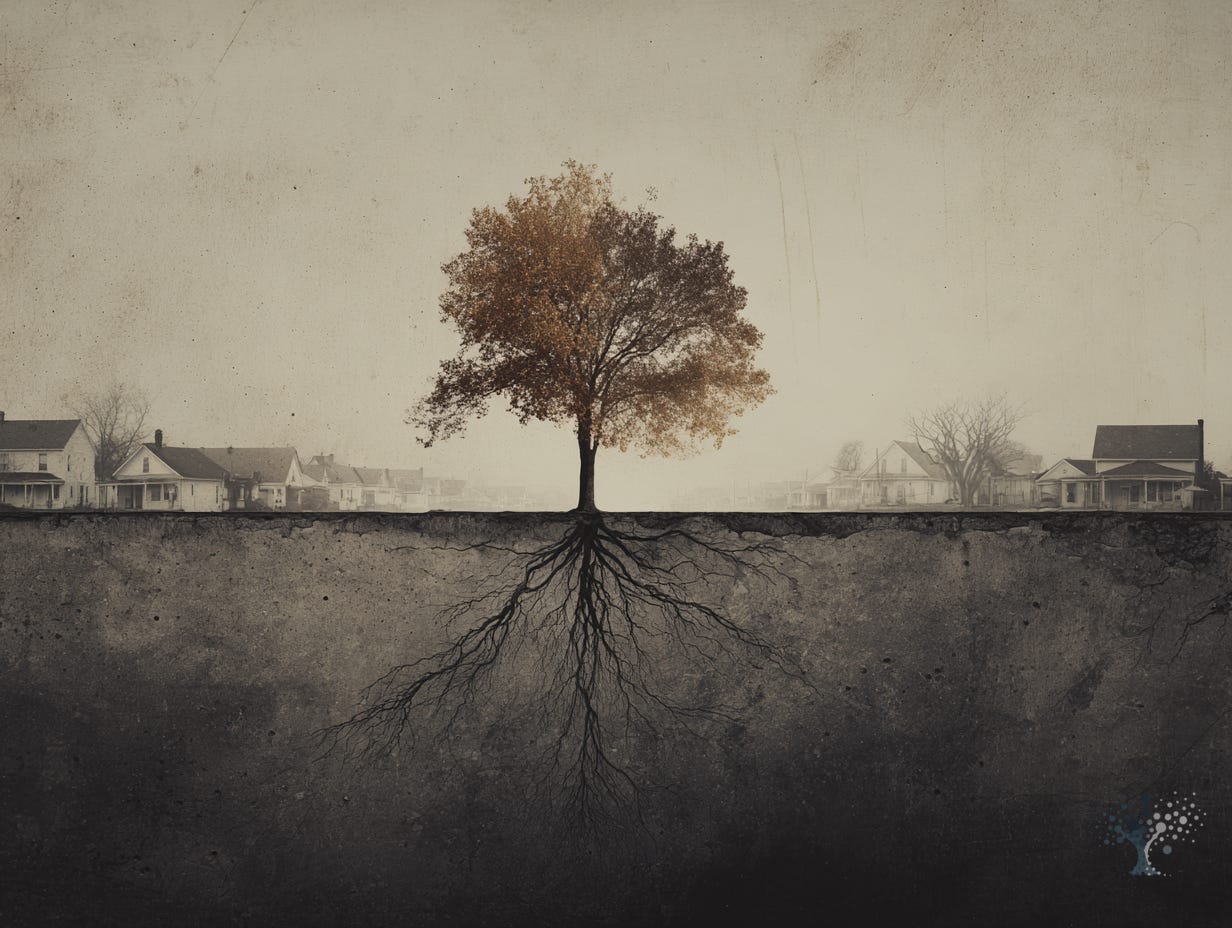
A nonprofit could work like that. A parent who shows up for food assistance on a Saturday meets another parent from the same school district. They stay connected after the distribution ends. One of them starts volunteering. The organization doesn’t just serve people — it begins to connect them, and those connections carry weight that a single program never could. That kind of compounding is available to almost any organization with deep community proximity. I have not seen many that have built for it.
The CARE framework describes exactly this kind of systems architecture. Seen through the evolution lens, each of its four surfaces corresponds to a different stage in the journey from impact to change.
CARE as Evolutionary Infrastructure
In Mission Surfaces, I introduced CARE as a framework for designing the surfaces through which a nonprofit’s mission actually touches people. Connect, Advance, Relationships, Exchange. Four surfaces that, when designed intentionally, form an ecosystem where each one feeds the next.
Seen through the lens of Ellen’s work, CARE is something more specific. It is the mechanism by which an organization evolves from impact to change.
Connect is where impact begins. It’s the surface where your mission reaches someone for the first time or removes a barrier that was keeping them out. Every organization has to do this early node-building work, and most stay here.
Advance is where impact deepens. The surface between touchpoints, where a participant’s outcomes develop after they leave your event, your class, your warehouse. Most nonprofits have their greatest gap here. The program ends, the relationship pauses, and the next cycle starts over. Designing for Advance means building continuity where there was none, turning episodic contact into ongoing development.
An organization that can only sustain itself by asking is an organization that can only grow with permission.
At the Relationships surface, one-time participation becomes ongoing belonging. Someone moves from recipient to member, volunteer, mentor, steward. The network starts to form, and the logic shifts from reach to density, from how many people you’ve served to how connected they are to each other and to the mission. Compounding begins here. The value of the network starts to exceed the sum of its individual nodes.
Exchange is the point at which change becomes self-sustaining. Value flows in multiple directions, among participants, between partners, through mechanisms aligned to mission. The social sector has historically treated donor cultivation as the primary financial skill a nonprofit needs, but an organization that can only sustain itself by asking is an organization that can only grow with permission. Entrepreneurial activity matters just as much. And financial independence, however it is achieved, is not systemic change. It is the precondition for it. What an organization does with that freedom determines whether it evolves toward change or stays at the impact level. Zenith Wealth Partners and its Impact Investing strategies are working to address this gap, equipping nonprofit leaders to move beyond grant dependency and the institutions that reward the status quo.

Together, these four surfaces describe a developmental sequence. Impact is the foundation. CARE is the architecture that lets an organization build upward from it. The reason so few do isn’t that the path is invisible. The structures surrounding most nonprofits make it nearly impossible to walk.
Why Most Organizations Stall
Ellen’s diagnosis of why the evolution rarely happens starts with funding. When a for-profit company builds something people won’t pay for, it finds out fast. Revenue disappears. Nonprofits don’t get that feedback. The people who fund the work and the people who benefit from it are almost never the same, and what funders want to see — stories, metrics, visible outputs — pulls in a different direction than what beneficiaries actually need. A funder wants to know how many people you served last quarter. A family facing housing instability needs the conditions around housing to change. Over years, that tension bends the whole organization toward impact, because impact is the thing you can photograph and put in a report.
C3 tax status compounds the problem, though not in the way most people assume. The legal structure under which most nonprofits operate prohibits partisan campaigning, but it does not prohibit lobbying or systemic advocacy. Organizations can elect under 501(h) to spend a defined percentage of their budget on legislative activity. The actual legal constraint is narrower than the sector treats it. What is wide is the chilling effect. Most nonprofits are so cautious about IRS rules, and so dependent on funders who prefer safe programmatic work, that they avoid systemic advocacy entirely. The constraint is cultural and funder-driven before it is legal. The result is the same either way: over decades, the tax code’s shadow shapes organizational identity more than the tax code itself.
It could be that fewer kids are cold, but how many more are about to be?
Then there is the career problem, which is harder to talk about. Entire professional ecosystems — executive directors, program managers, development officers, grant writers — depend on the continued existence of the issues their organizations were created to address. Nobody gets into nonprofit work hoping the problem persists. But the institutional machinery is calibrated around continuity, and when your annual budget requires the problem to still be there next year, the incentives for making yourself unnecessary get complicated fast.
I saw this tension up close at Darren Sudman’s Nonprofit Night at the Pyramid Club in Philadelphia, where I learned about Operation Warm, an organization that has distributed coats to children for over thirty years. Grace Sica, their Executive Director, spoke about innovative solutions inside a nonprofit, and the passion in the room was real. Operation Warm does important work. Kids who need coats get coats. The organization has built genuine relationships with the communities it serves and earned the trust that comes from showing up consistently for three decades.
Thirty years of sustained downstream delivery is an achievement worth respecting. But has the underlying condition changed? It could be that fewer kids are cold, but how many more are about to be? An organization can be deeply effective at the Connect level and still be structurally unable to evolve beyond it, because nothing in its design was built for that leap.
When Change Comes From Outside

What happened in Philadelphia’s foster care system shows what it looks like when one of the other engines drives change while nonprofits remain at the impact level.
Since 2017, Philadelphia’s Department of Human Services has reduced the number of children in foster care by nearly 60%, driven by policy reforms focused on keeping families together rather than separating them at the point of crisis. The city expanded legal representation for families under investigation, connected them with social workers and peer advocates, and began treating poverty as a condition to address rather than a form of neglect to prosecute. The engine of change was the city itself, acting on the structural conditions that fed the foster care pipeline.
What happened to the nonprofits? They had to adapt their business models. Organizations that had built their operations, staffing, and funding around the assumption of a large foster care population suddenly faced a shrinking problem. Some pivoted. Some struggled. The systemic shift came from a policy actor, not from the organizations closest to the families.
The nonprofits had the community knowledge, the relationships, the trust. They understood the problem at the human level better than any government office could. But they lacked the structural capacity to translate that understanding into upstream intervention. The city had the authority to change conditions. The nonprofits had the proximity to know which conditions needed changing. What was missing was an organization that had both.
Evolving through CARE is designed to address exactly this gap. An organization with strong Relationship and Exchange surfaces has something a pure impact organization does not: a network with enough connective density to exert systemic influence. It has moved beyond linear delivery into something that begins to close the distance between proximity and power. Whether any nonprofit has actually completed that journey at scale is an open question. The architecture for it is becoming visible.
Proximity Without Power
Organizations cannot create change unless they are designed to learn across surfaces, retain value across cycles, and turn proximity into coordinated intelligence. Ellen and I keep arriving at that claim from different directions, so let me try to explain what I mean by it.
Start with the learning problem. A food pantry knows which families are most vulnerable in its neighborhood. Volunteers see the same faces, hear the same stories, notice when someone stops coming. That knowledge is real and it is valuable. But it usually stays in a volunteer’s memory or a spreadsheet that no one reads. It never travels from the Connect surface to Advance, never shapes how the organization designs its next program. Most nonprofits treat each program as self-contained, which means the insights generated at one surface never inform the others. The organization serves, resets, and starts over.
The social sector's real advantage has never been compassion — compassion is widespread. The advantage is proximity.
The retention problem is related. If every funding cycle starts from scratch — new grant application, new reporting requirements, new proof that the problem still exists — then nothing the organization learned last year carries forward structurally. An organization that retains value across cycles gets smarter over time. Its relationships deepen, its understanding of the system it is trying to change gets more refined, and it builds the kind of institutional knowledge that makes upstream action possible. I don’t see many nonprofits that have built the architecture for that. Most of them are running too hard to pause and build it.
The hardest part is turning all of that proximity into something coordinated. Nonprofits are already in the neighborhoods and the shelters. They see patterns that government agencies miss and that for-profit companies have no reason to look for. But seeing a pattern and being able to act on it structurally are different things. The Philadelphia nonprofits understood the foster care problem at the family level better than anyone. They still couldn’t translate that understanding into the policy shift that the city eventually made on its own. Proximity without coordination is just awareness. It becomes power only when an organization can move what it knows across its surfaces and cycles and into something that changes conditions.
Ellen’s spectrum describes where organizations sit. The evolution model describes what it takes to move. I think the design principle underneath both is that the social sector’s real advantage has never been compassion — compassion is widespread. The advantage is proximity to the people most affected by the problems society keeps failing to solve, and that advantage is being wasted by organizations that cannot hold what they learn long enough to act on it.

CARE is one way to think about the architecture that would be needed. Surfaces that compound rather than reset. Relationships that build into networks over time. Revenue models that give organizations the independence to pursue change without waiting for a funder’s permission. The underlying commitment would be to treat every interaction as a source of intelligence rather than a transaction to be counted and reported.
Not every nonprofit should evolve toward change in the same way. Crisis hotlines, disaster-response food banks, emergency shelters — these exist to provide immediate relief, and that work does not become less valuable because it operates at the impact level. But the sector as a whole needs far more organizations that can make the evolution. The ones with the deepest community relationships and the longest track records of trust are often the best positioned to try, and right now almost none of them are being designed for it.
For-profit companies and the government will continue to reshape society. They always have. Their changes will continue to be disconnected from the people most affected, optimized for markets or political cycles rather than human outcomes. The social sector is the only engine with the proximity and the mission to close that gap. It has spent decades getting very good at impact. Whether it can learn to scale like the other two engines without losing the thing that makes it irreplaceable is the question that Ellen’s work, and this series, keeps circling back to.
Ellen and I are trying something new to bring awareness to this connection between scaling impact and driving change. We have started working out an idea around mission alignment and we are calling it Mission Aligned. Our mission: "We help nonprofits sustain their work, amplify their impact, and create lasting social change." Sign up for early access.
This is part of the Designing Intelligence series, exploring how human and machine intelligence evolve together through design, stewardship, and knowledge systems.
Really well written. 🔥This is such a clear and thought-provoking distinction between impact and change. While I don’t work for a nonprofit and haven’t had direct experience in that world, the “linear trap” really resonated with me... especially the idea that we can keep repeating helpful actions without changing the core problem!