

The Wrong Game: Why AI Needs Dungeon Masters, Not Proctors
On rule-making, co-op learning, and what we get wrong when we treat intelligence as solo work.


A 133-year reversal
This month, Princeton’s faculty voted, with only one dissent, to end one of the oldest experiments in American higher education. Beginning July 1, professors will sit in exam rooms and watch students take tests. The honor code, which had governed Princeton examinations since 1893, did not survive the arrival of generative AI.
The official reasoning is reasonable. Students could no longer spot cheating done on small devices with large models, and the honor code depended on conditions that no longer hold.
It tightened the rules of a game it had already decided was the right one to be playing.
But notice what kind of change. Faced with new cognitive capability in the world, the university went back to watching in person. It tightened the rules of a game it had already decided was the right one to be playing.
That observation is the essay. With AI moving into classrooms, workplaces, and products at every level, the harder question is whether the old game still fits at all. What game are we really playing?
The age of solo games

Most of what we call “using AI” is single-player. One person, one prompt, one model, one output. The game is closed. The win condition is correctness, speed, or fluency. The rest of the world is not at the table.
That is what most products optimize for and what most school policies are now reacting to. The threat is the same: a lone student getting an answer they did not produce alone.
Solo play is not bad. It is often useful. But it is the lowest-resolution version of what intelligence with AI can be, and it mistakes a small part of the experience for the whole.
What game are we really playing?
I have been thinking through games for most of my life. I medaled at the state level in chess in high school, drawn to the English Opening because it rewarded thinking about the shape of the whole position more than calculating one move ahead. The games I have lived with since are mostly ones where the world is partly invented as the players move through it. That shift is not just mine.
Solo video games gave way to multiplayer. The most enduring tabletop game of the last fifty years is Dungeons & Dragons, not solitaire.
What D&D actually is
D&D is a system in which several humans use evolving rules, distributed roles, and a shared imaginary environment to make meaning together in real time. A dungeon master sets the world, frames the stakes, and steers the constraints. The rules are partly fixed and partly negotiated. Winning is collective leveling, where the party’s range of capability grows with the world it has explored.
This is, in Katie Salen and Eric Zimmerman’s Rules of Play: Game Design Fundamentals, what every well-designed game does. Rules do not constrain play. They constitute it. The play emerges from the friction between rule and choice.
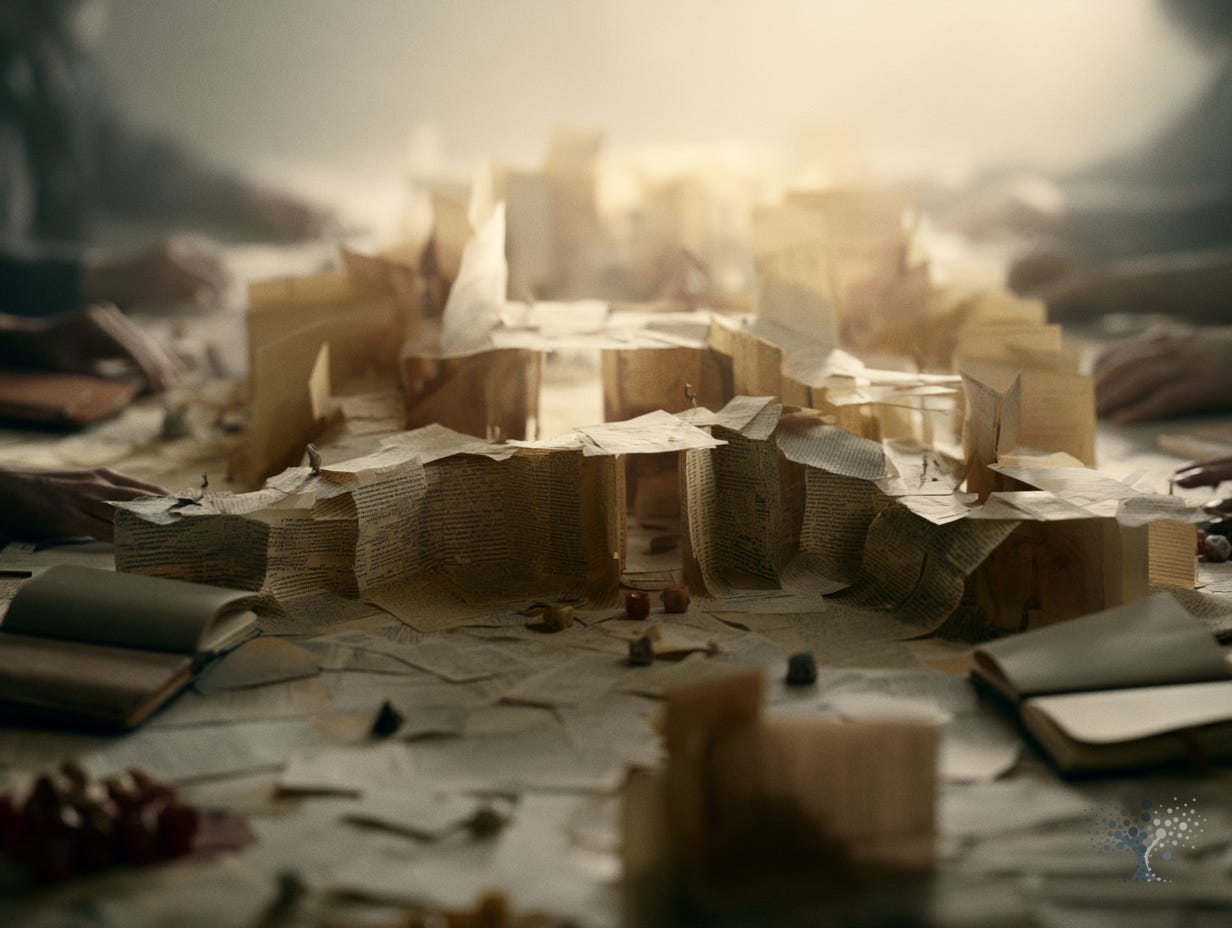
Which, incidentally, does sound like what is happening at Princeton. Students got AI as a new piece of equipment, and they tried things the rule set did not anticipate. The honor code became incomplete. Tightening the rules treats the symptom. The deeper move would be to recognize the game has changed.
I have played enough chess to know what closed games reward. Finite, deterministic, complete-information. The beauty is depth inside a small space; the cognition is pattern recognition under constraint. D&D is built on the opposite principle. The world is shaped by what the players do. The beauty is coverage across an open space; the cognition is coordinated improvisation. Both are real. Only one looks like what most AI products are currently designed to support.
Most AI products today are built like chess boards. The work ahead is to build more tables.
This is the games-shaped version of a shift I have been tracking elsewhere. In The Fall of Deterministic Problem-Solving and the Rise of Probabilistic Strategies, I argued that success in AI-shaped environments comes less from controlling every input and more from creating conditions where useful patterns can arise. A chess board fixes the inputs. A D&D table shapes the conditions. Most AI products today are built like chess boards. The work ahead is to build more tables.
Teachers as dungeon masters

AI built only for solo prompting is a chess move. The systems we should be designing are D&D campaigns. Which brings the question back to Princeton, and to every other institution reaching for outdated ways to manage students playing a different game.
The temptation, when intelligence becomes easier to access, is to tighten controls around individual work. Lock the laptop and watch the room. In game terms, it tries to keep playing solo at a moment when the game has already become something else.
A better move is harder. Treat the educator less as a referee and more as a dungeon master. The DM does not write the students’ moves. They design the world, set the stakes, and shape a setting where different strengths matter at different moments. The party levels up because the world is built well, not because the rules were strict.
Most schooling still asks every student to achieve the same level on the same timetable. That works inside a chess model of intelligence. It works poorly when one student is suddenly good at structuring a problem, another at evaluating evidence, and the AI at the table adds a strength neither has. Co-op play presumes the team’s coverage of the problem space matters more than any single player’s mastery. Most schools have not designed for that.
I remember elementary school differently. In mine, you progressed through your subjects at your own pace. Some kids were two grade levels ahead in math and one behind in reading. Some were the opposite. The classroom did not pretend we were all at the same place. The work was still solo, but it was tailored. My children’s school does not run that way. Every student is asked to work alone and to be at the same level at the same time, regardless of their actual strengths and weaknesses. The system is easier to administer. I am not sure the outcomes are better.
The AI is one participant in a party of five, not a hidden tutor in five separate sessions.
AI lets us try something neither version of school has tried. Treat the classroom as a co-op party. Lean on the strengths and weaknesses across the class. A teacher in that mode is genuinely a dungeon master. They set the table. The algorithm of success can be discovered rather than coded in advance. One student’s strength carries another’s weakness for a stretch.
AI is well shaped to support this, if the system is designed for shared context. It can respond to what students try, surface patterns, adjust the challenge, and help the teacher shape the field as the party moves.
None of this eliminates individual capability. It contextualizes it. A D&D party is only as strong as the characters in it, and a character is only as strong as the player has actually developed. Hiding behind the party, like hiding behind a model, is a failure mode the dungeon master is meant to notice and correct. Students still need to write, reason, calculate, remember, and judge on their own. Those capabilities are what the player brings to the table when the larger game begins.

This shifts what assessment is for. The DM is not tallying what each player did right. They are watching where each one stepped back, and why. The reasons cluster into a skill gap, intimidation by the pace, or simple free-riding. None of them is a multiple-choice test. The exam, in this model, is a debrief: explain what the party did, why you did not drive that part, and how you would do it alone. Reading those gaps takes more observation than standardized tests demand. Small classes or a shared workspace that flags engagement can carry the load.
This is not an argument for nostalgia or for unstructured learning. The dungeon master role is harder than the proctor role. The rules must be richer and the world more legible. Progress has to be visible enough that students and teachers can both see when capability is growing. Leveling up is a real and observable answer to whether you won. Most schools have stopped giving any such answer.
What changes if we believe this

If the next era of AI is a co-op game, then a lot of what we currently build is shaped wrong.
Solo-prompt interfaces will have to become interfaces for shared turns. Workflows built around individual output will start tracking ensemble learning. Assessment, in school and at work, has to extend from individual production to team capability. The rule set itself becomes the design problem.
The design pattern is straightforward. Instead of every student getting their own private AI assistant, the model sits in a shared workspace where the whole team can see it. Students take turns directing it and evaluate its outputs together. The AI is one participant in a party of five, not a hidden tutor in five separate sessions. This is the role I have called the AI conductor: intelligence designed to connect rather than replace.
The training we should be doing looks more like game design than prompt engineering. It is about preparing students to enter rooms where the rules are partly given and partly being made in real time, with humans and machines as fellow players.
The question is whether we are tightening the rules of the wrong game.
Eliezer Yudkowsky has written about a property he calls oneshotness, where catastrophic failure means no retry. A Mars probe is oneshot. A startup, at the scale of the founders’ careers, is oneshot. Most small games inside a life are not; some of the larger ones are.
The wrong-game problem has the same shape. A proctored exam can be retaken, a product release can be patched. The larger games those small games sit inside often have fewer tries. A generation trained to hide AI use, instead of learning how to coordinate with it, may develop habits that are harder to unwind than an exam policy. The local game looks safe. The larger one may not be.
Princeton’s reversal is a small, real signal. The next move is to design the larger game we are already standing inside, the one that wants dungeon masters more than proctors.
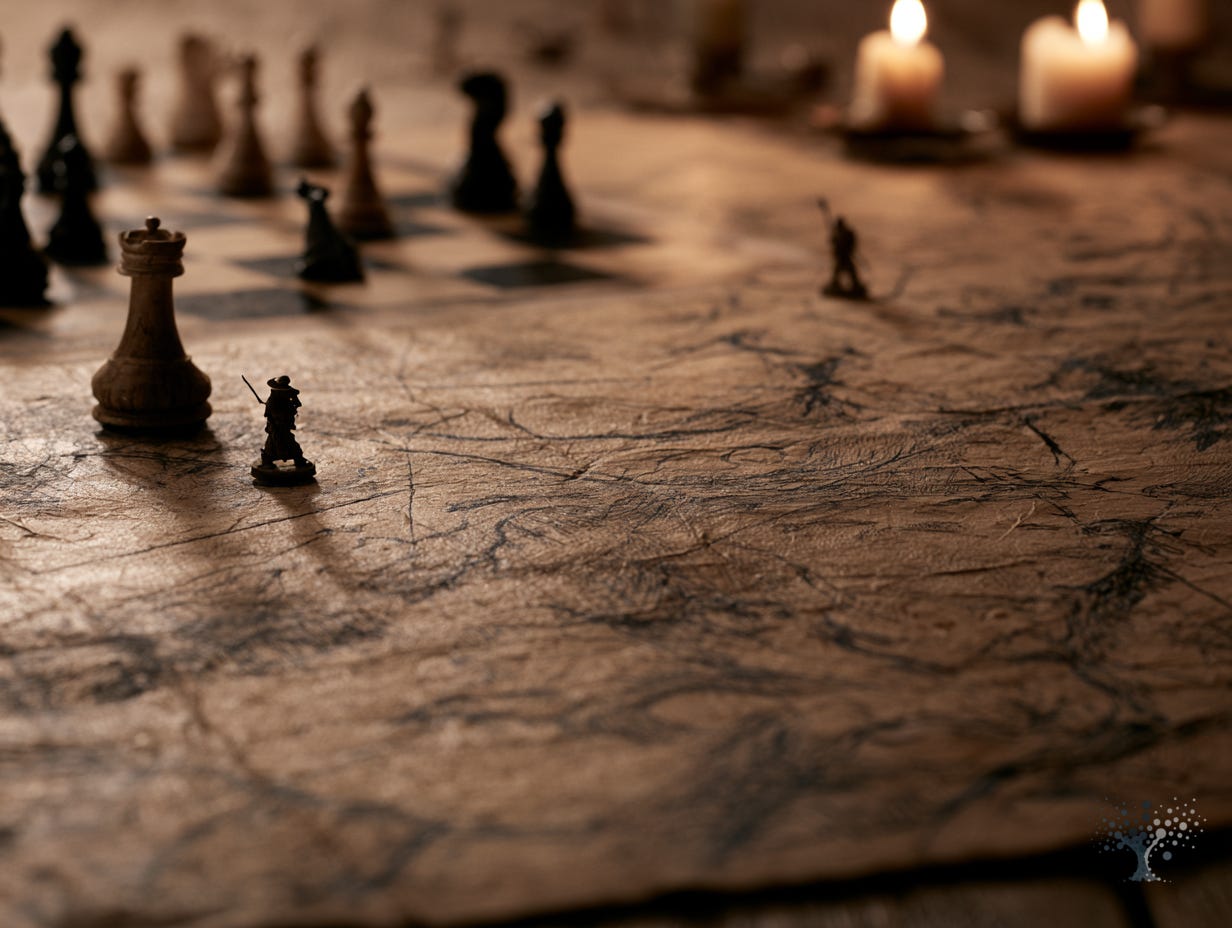
Treat this as the inspirational shape. The operational version, with its shared workspace, role rotation, longitudinal artifacts, gap reading, and peer-uptake metric, is its own essay. The Right Game comes next. The case here is that the operational work would be worth the trouble.
We are not in the age of AI tools. We are in the age of new games, played by humans and machines together, with rules we have barely begun to write. The question is whether we are tightening the rules of the wrong game.
Sources and attributions:
Jason Prunty, The Fall of Deterministic Problem-Solving and the Rise of Probabilistic Strategies, Designing Intelligence (July 2025).
Jason Prunty, The AI Conductor, Designing Intelligence (September 2025).
Eliezer Yudkowsky, Irretrievability; or, Murphy’s Curse of Oneshotness upon ASI, LessWrong (May 2026). I borrow the concept; the application here is broader than Yudkowsky’s specific argument about ASI alignment.
Katie Salen and Eric Zimmerman, Rules of Play: Game Design Fundamentals (MIT Press, 2003).
On Princeton’s May 2026 faculty vote ending 133 years of unproctored exams: Inside Higher Ed, The Daily Princetonian, Princeton Alumni Weekly.